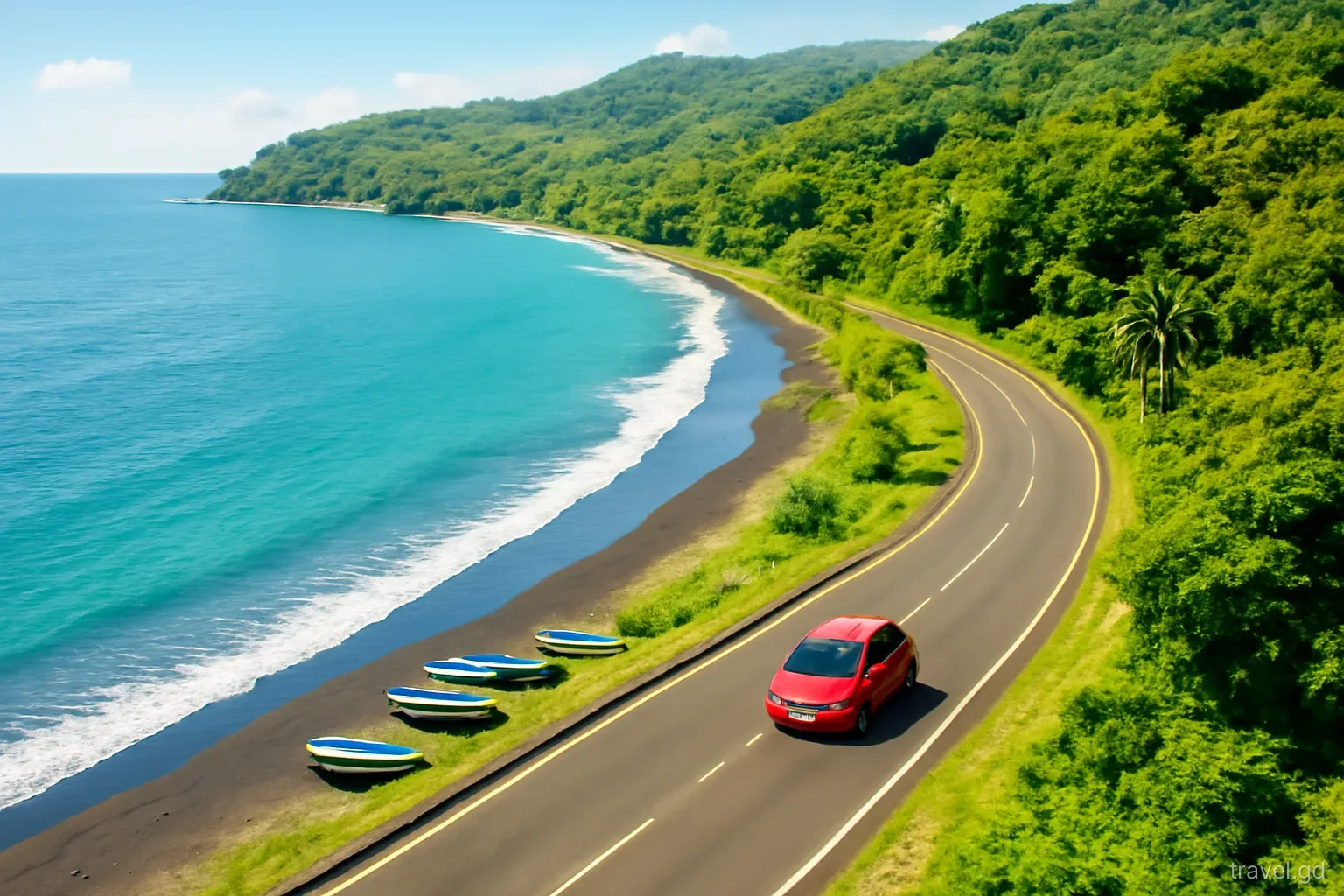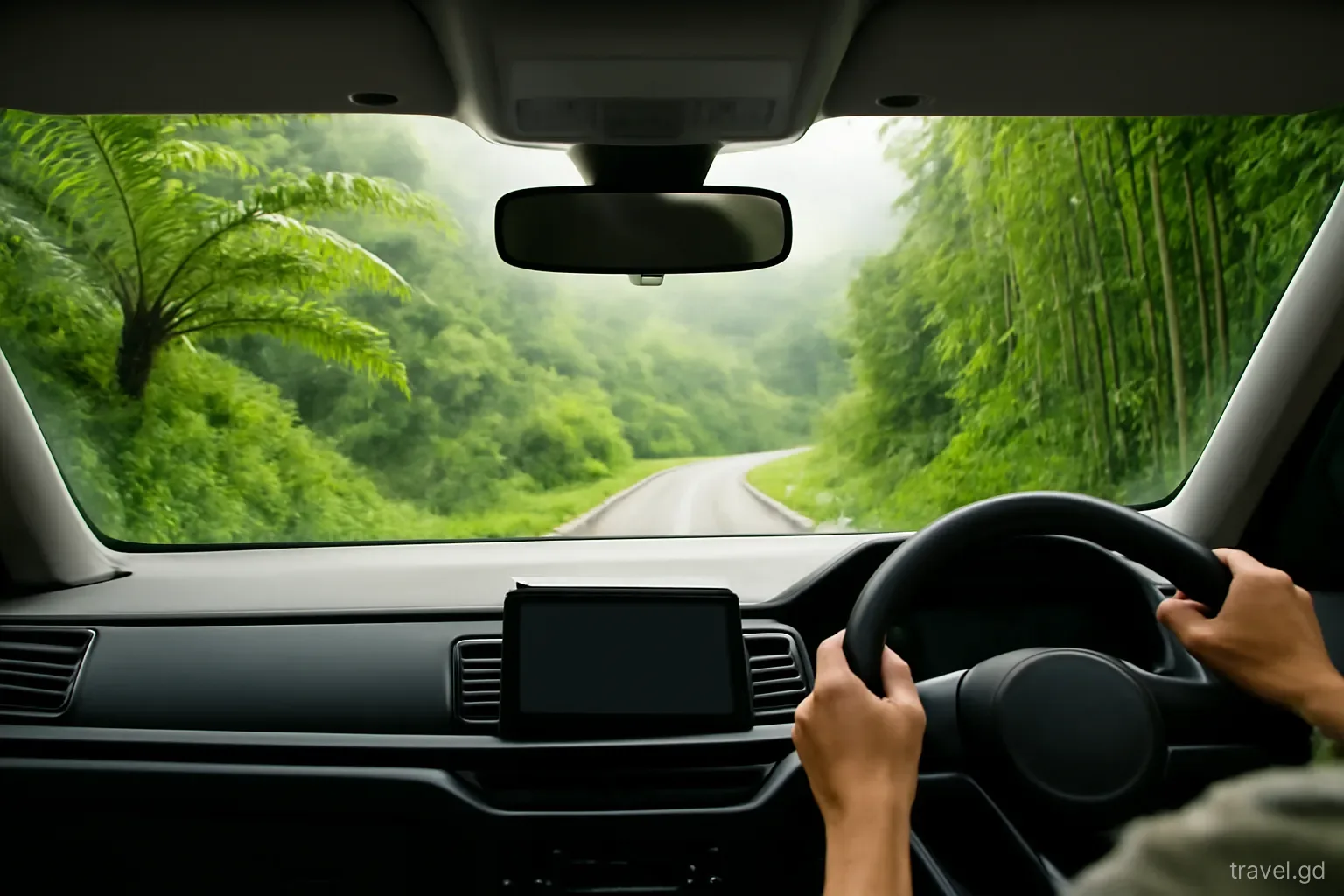
Driving in Grenada is less about speed and more about attention. The roads are narrow, steep and full of bends, the edges drop into deep concrete drains, and the traffic includes fast minibuses, walking schoolchildren, parked trucks and the occasional goat. Locals drive these roads every day with confidence; visitors who arrive expecting motorway habits are the ones who end up with a wheel in a drain.
None of this should put you off. With a few adjustments, most visitors find driving here manageable within a day, and the freedom it brings is worth it. This page sets out what is different, what catches first-timers out, and the habits that make the difference between a stressful drive and an enjoyable one.
The basics: left side, low speeds, constant hills
Traffic keeps left. If you are used to driving on the right, the hardest moments are not on the open road but when pulling out of a car park, turning at a junction or leaving a petrol station, when instinct takes you to the wrong side. Saying "stay left" out loud for the first day sounds silly and works. At roundabouts, give way to traffic from the right and go round clockwise.
Speeds are low, and they need to be. Speed limits are posted on some roads and are modest by North American or European standards; in practice, the bends and gradients set the real limit. On the hills around St George's and in the interior, you will spend a lot of time in low gears. An automatic helps, but on very steep sections even an automatic benefits from using a lower gear on the descent to avoid overheating the brakes.
Seat belts are expected for everyone in the car, and drink-driving is an offence. Keep your phone out of your hand while driving; on these roads you need both hands and full attention.
What catches first-timers out
The drains. Many roads have deep open concrete drains, sometimes called gutters, right at the edge of the tarmac with no kerb or verge. Drop a wheel in one and the car is stuck, often damaged, and needs help to recover. Keep a clear margin from the edge, especially when passing oncoming vehicles on narrow stretches.
Blind bends. Hairpin bends on hillsides hide oncoming traffic. Local drivers sound a short tap on the horn before a blind corner to warn whoever is coming. It is not aggression; it is courtesy and safety, and you should do the same.
Minibuses. The privately run buses stop wherever a passenger waves or asks to get off, often without warning, and pull out again quickly. Leave a generous gap behind them, and do not be pressured by one close behind you; pull in where safe and let it pass.
Pedestrians and animals. Many roads have no pavement, so people walk in the road, including children going to and from school. Goats, dogs, chickens and sometimes cattle wander onto rural roads. Slow down through villages.
Potholes and speed bumps. Road surfaces vary, from smooth new tarmac to deep potholes, particularly after heavy rain. Unmarked speed bumps appear in villages. Watch the road ahead, not just the bend.
Parked vehicles. Trucks and cars stop on the road to load, chat or buy something at a roadside stall. Expect to find the lane blocked around a corner.
Overtaking. Long straight stretches are rare, and overtaking on a bend is how serious accidents happen. Only pass where you can see well ahead, and accept that you may follow a slow truck for several kilometres on the hills.
Flashing headlights and hand signals. Drivers sometimes flash their lights or wave to let you out of a junction or to say thank you. Do not assume a flash always means go; look for yourself before pulling out.
St George's: tunnel, one-way streets and parking
Driving into St George's is the most demanding part of the island for a visitor. The town is built on steep hills around the Carenage, the streets are narrow, many are one-way, and pedestrians step out between parked cars. Traffic builds on the roads from Grand Anse, including the Lagoon Road along the waterfront, at morning and late-afternoon rush hours and when cruise ships are in port.
The Sendall Tunnel, a narrow tunnel built in the 1890s, links the Carenage side of town with the Esplanade and the bus terminal. It is short but tight, shared by vehicles and pedestrians, and it is worth going through slowly and following the traffic flow rather than hesitating at the entrance.
Parking is the real challenge. Street spaces are limited and some areas are restricted, so if you plan a day in town, consider parking on the edge and walking, or leaving the car at your hotel and taking a bus or taxi in. For a morning at the market or the Fort George viewpoint, a midweek visit on a day without cruise ships is far easier.
Night driving and rain
Darkness comes early and quickly, soon after six in the evening for most of the year. Outside the south-west, many roads are unlit, and the combination of bends, drains, pedestrians in dark clothing and unfamiliar routes makes night driving tiring and riskier. Plan day trips so you are back at your base, or at least on familiar roads, before dark. If you are going out for dinner, choose somewhere close by or take a taxi.
Tropical showers can be heavy and sudden, especially in the interior around Grand Etang and in the wetter months from June to November. Roads become slippery, particularly smooth concrete sections on steep hills, and water rushes along the drains and across the road. Slow right down, increase your following distance, and if visibility drops sharply, pull over somewhere safe and wait; most downpours pass quickly.
After heavy rain, check before driving routes with landslip risk in the hills. Local people and your accommodation will know which roads are affected.
Habits that make it easy
These are the small routines experienced visitors settle into after a day or two.
- Plan the route before setting off, and download an offline map; signal on some interior roads is weak.
- Ask locally for directions when in doubt; people are generally happy to help, and directions are often given by landmarks such as churches, shops and schools.
- Fill up when the tank is half empty if heading north or into the interior, where fuel stations are fewer.
- Carry water, a charged phone and the rental firm's breakdown contact.
- Park off the road where possible, and never leave valuables visible in the car.
- Keep the first day's driving to the south-west, where roads are busier but simpler.
- Let faster local drivers pass; there is no prize for holding a queue on a mountain road.
If something goes wrong
For a puncture or a minor problem, pull off the road where it is safe and call the rental company. Most can send help or talk you through changing a wheel. If a wheel drops into a drain, do not try to force the car out, which tends to damage the underside; local people will often stop to help lift, and the rental firm can arrange recovery.
In a collision, stay at the scene, make sure everyone is safe, and call the police; the emergency number is 911. Take photographs of the vehicles, their positions and any damage, and exchange details with the other driver. Contact the rental firm as soon as possible, since a police report is usually required for any insurance claim.
If you are stopped at a police checkpoint, which happens on main roads, have your home licence, the Grenadian local permit and the rental agreement ready. Checks are routine and usually quick.
Frequently asked questions
Is it hard to drive in Grenada?
It takes adjustment rather than special skill. Roads are narrow, steep and winding, traffic keeps left, and deep drains line many edges. Most visitors are comfortable after a day, especially if they start in the south-west, drive slowly and avoid night driving at first.
Why do drivers in Grenada honk on bends?
A short tap of the horn before a blind bend warns oncoming traffic that a vehicle is coming. It is normal, polite practice on narrow mountain roads, not a sign of anger. Visitors should use it the same way on tight corners.
Is it safe to drive in Grenada at night?
It is possible, but harder. Many roads outside the south-west are unlit, and bends, drains and pedestrians are difficult to see. Plan longer drives for daylight, and use taxis for evening outings until you know the roads well.
What should be done if a car goes into a drain in Grenada?
Stop, switch off and do not force it, which can damage the underside. Call the rental company for recovery. Local people often stop to help lift a car out, but let the rental firm know what happened in any case.
Where is it easiest to park in St George's?
Street parking in St George's is limited and the streets are narrow and hilly. Many visitors park on the edge of town and walk, or avoid driving in altogether by taking a bus or taxi, especially on cruise-ship days.