Grenada's electricity follows the British pattern, not the American one. The standard socket is the rectangular three-pin type G used in the United Kingdom, and the supply is 230 volts at 50 hertz. Visitors from the UK and Ireland can usually plug straight in. Visitors from the United States and Canada, used to two flat pins and 120 volts, need at least an adapter and sometimes more.
That one fact sorts out most charging questions, but there are wrinkles: some hotels have added American-style outlets, many devices are dual voltage while some are not, and power cuts happen, particularly after storms. This page explains what to check on each device, what to buy before you fly and what to expect once you are plugged in.
The basics: socket shape and supply
The type G socket has three rectangular holes in a triangle, and plugs often contain a fuse. Electricity across mainland Grenada, Carriacou and Petite Martinique is supplied by GRENLEC, the Grenada Electricity Services company, at 230 volts and 50 hertz. These are the numbers to compare with the label on your charger or appliance.
Some hotels, villas and newer guesthouses also fit sockets that take American two-pin plugs, sometimes with a separate 110-volt shaver point in the bathroom. This varies from room to room and building to building, so do not assume it. If a socket looks American, it may still deliver 230 volts, and that is the detail that damages single-voltage equipment.
If your accommodation is a self-catering apartment or a private villa, ask the host in advance what sockets the rooms have and whether they keep spare adapters. Many do, but they tend to disappear from rooms over time. Yachts are a separate case: many charter boats run on 12-volt systems with an inverter for limited mains use, so check with the charter company what can be charged on board and when.
How to check whether a device will work
Before you pack anything with a plug, read the small print on its charger, power brick or base. It takes a minute per item and prevents the classic holiday smell of melting plastic.
- Find the line marked INPUT on the charger or label.
- If it says something like 100-240V, 50/60Hz, the device is dual voltage. It needs only a plug adapter to fit the type G socket. Almost all phone, tablet, laptop and camera chargers fall into this group.
- If it says 110-120V only, the device is single voltage. Plugging it into Grenada's supply through a simple adapter can destroy it. You need a step-down voltage converter of suitable wattage, or you leave the item at home.
- Check the wattage of heating appliances: hair dryers, straighteners, curling tongs, travel kettles and some electric toothbrush chargers. High-wattage single-voltage items need heavy converters that are rarely worth carrying.
- Look for a dual-voltage switch on hair tools. Some have a small slider that must be moved to 230 before use.
- Count your devices and buy adapters accordingly. One adapter per person plus a multi-port USB charger is usually enough.
What to buy before you leave
A type G adapter, or two. Buy them at home. They are sold in Grenada at supermarkets, hardware stores and some pharmacies, but not always near where you are staying and not always on the evening you arrive.
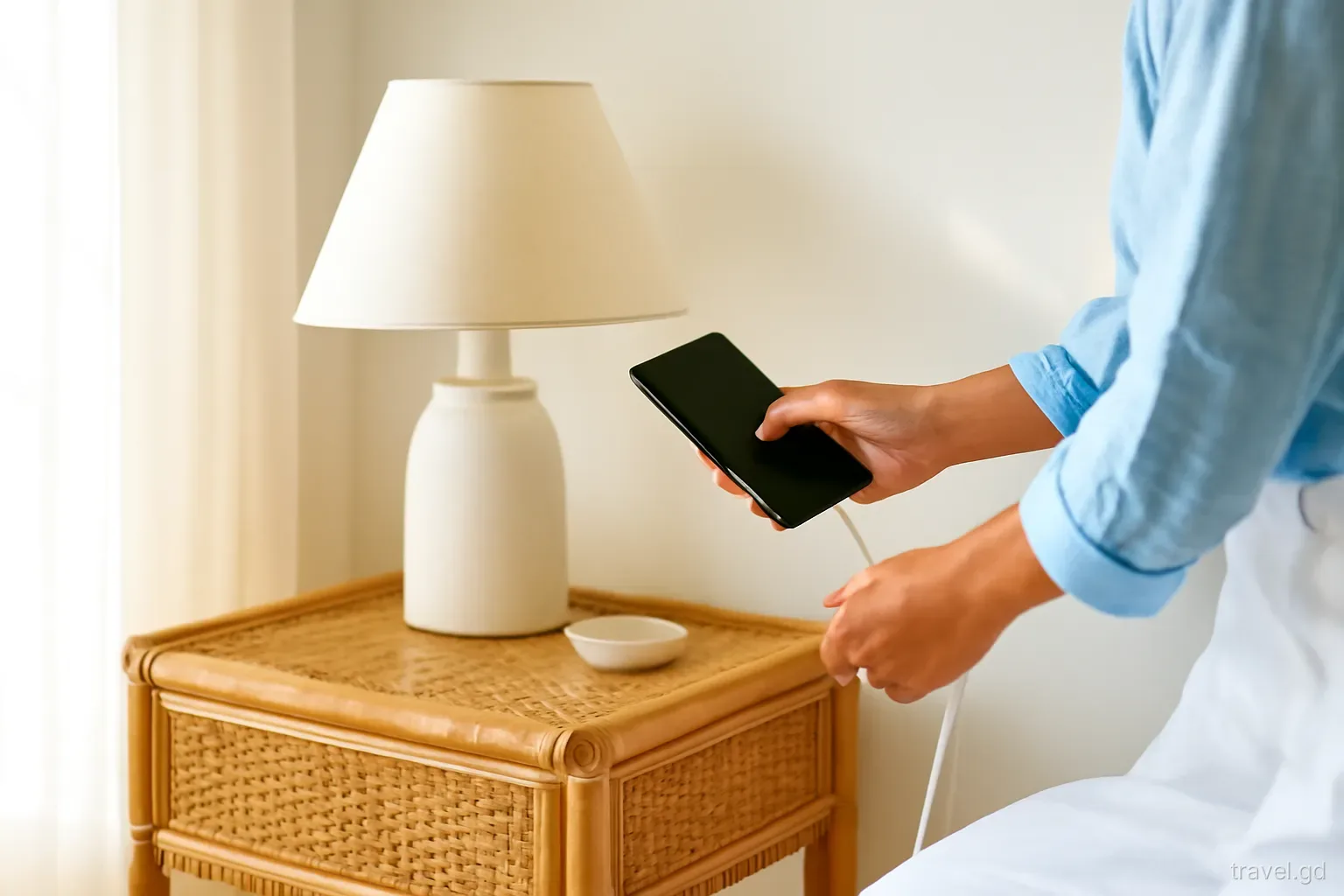
A multi-port USB charger. A single wall charger with three or four USB-A or USB-C ports, plugged into one adapter, charges phones, watches, earbuds and a power bank at once. It also gets around rooms with only one free socket near the bed.
A universal adapter if you travel widely. Travellers combining Grenada with Trinidad, Barbados or other islands should note that sockets vary across the Caribbean. A universal adapter with sliding pins covers most combinations.
A power bank. Useful for long tour days, boat trips and the occasional outage. Airlines require power banks to travel in hand luggage, not in checked bags, and set limits on capacity.
A short extension lead or travel strip. Older rooms sometimes have a single socket in an awkward corner. A compact multi-socket strip with a type G plug, or a travel strip that accepts your home plugs and plugs into one adapter, turns one outlet into several. Avoid daisy-chaining adapters, which overheat.
Dual-voltage hair tools. If you cannot live without a hair dryer, check whether your accommodation supplies one. Most hotels do. Otherwise, a compact dual-voltage model is far simpler than a converter.
Power cuts, surges and storm season
Supply on the main island is generally reliable, but short outages happen, and longer ones can follow heavy rain, high winds or a tropical storm. Hurricane Beryl in July 2024 caused severe, prolonged damage to the electricity network on Carriacou and Petite Martinique; rebuilding has continued since, and visitors to the sister islands should check current conditions with their accommodation before travelling.
Many hotels and larger guesthouses have back-up generators; smaller self-catering places may not. If keeping a device powered matters to you, perhaps for medical equipment such as a CPAP machine, ask directly whether the property has a generator, what it powers and how quickly it switches on.
Surges sometimes accompany the return of power. Unplugging laptops during a cut, or using a travel surge protector, is a sensible habit. Keep a torch or head torch by the bed, a fully charged power bank, and phone battery saver ready, particularly between June and November.
Staying charged away from your room
A typical Grenada day takes you away from a socket for many hours: a full-day island tour from St George's to Sauteurs and back, a catamaran trip up the west coast to the underwater sculpture park, or a hike to a waterfall in the interior. Phones work hard on those days, running navigation, cameras and messaging apps, and mobile signal in the hills and on the north-east coast can be patchy, which drains batteries faster as the phone searches for a network.
Charge everything overnight, carry a power bank of 10,000 milliamp-hours or so, and keep a short cable in your daypack. On boats, keep the power bank and phone in a dry bag; salt spray and electronics are a poor combination. Some tour vehicles have USB ports, but do not count on it.
Cafes, restaurants and bars in Grand Anse, the Lagoon Road and the Carenage often let customers charge a phone if you ask politely, though sockets near tables are not always available. If you are hiring a car, a dual-port car charger is the easiest way to arrive at your next stop with a full battery. Download offline maps of the island before long drives, so navigation keeps working when the signal drops.
Mistakes that cost visitors their devices
Trusting the shape of the socket. An American-shaped outlet in a Grenadian room does not guarantee American voltage. If there is no label, ask reception before plugging in single-voltage equipment.
Using an adapter as if it were a converter. An adapter changes the plug shape only. It does nothing to the voltage. This is the single most common cause of burnt-out hair straighteners in the Caribbean.
Overloading a cheap converter. Small converters are rated for low-wattage electronics. Running a 1,800-watt hair dryer through one usually ends badly for both.
Charging on wet surfaces. Humidity, sand and pool-side tables do not mix with cheap chargers. Keep plugs dry, especially on balconies and in bathrooms.
Leaving the adapter behind. Adapters left in hotel walls are among the most common forgotten items. Do a socket check on the last morning, together with the safe and the bathroom.
Forgetting the car. If you hire a car, a USB adapter for the car's power socket keeps navigation running on long drives to Sauteurs or Grenville, where signal can drop and battery drain rises.
Frequently asked questions
Will an American phone charger work in Grenada?
Almost certainly yes, with a plug adapter. Modern phone chargers are rated for 100 to 240 volts, so they handle Grenada's 230-volt supply. You only need the adapter to change the two flat pins into the British three-pin shape.
Do UK plugs work in Grenada without an adapter?
Yes. Grenada uses the same type G socket and a similar voltage, so British plugs fit and work. Visitors from Ireland, Malta, Cyprus and other type G countries are in the same position.
Can you buy an adapter after arriving?
Usually, yes. Supermarkets, hardware shops and electronics stores around St George's and Grand Anse sell them. Selection and price vary, and arriving late in the evening may leave you without one until morning, so bringing one is easier.
Does Carriacou use the same plugs?
Yes. Carriacou and Petite Martinique are part of the same country, with the same type G sockets and voltage. After Hurricane Beryl in 2024, supply on the sister islands was badly disrupted, so confirm the current situation and generator back-up with your accommodation.
Is it safe to bring a single-voltage hair dryer with a converter?
It can work if the converter is rated well above the dryer's wattage, but such converters are heavy and expensive. Most hotels provide a hair dryer, and a dual-voltage travel dryer is a lighter, cheaper and safer alternative.